



The Art & Science Behind Language that Works


We often talk about communication as an art—and it is. But that’s only part of the equation.
As linguists at maslansky + partners, we’re trained to see the other side: the science of language.
But what do we mean by that? And why does it matter outside of the academic classroom?
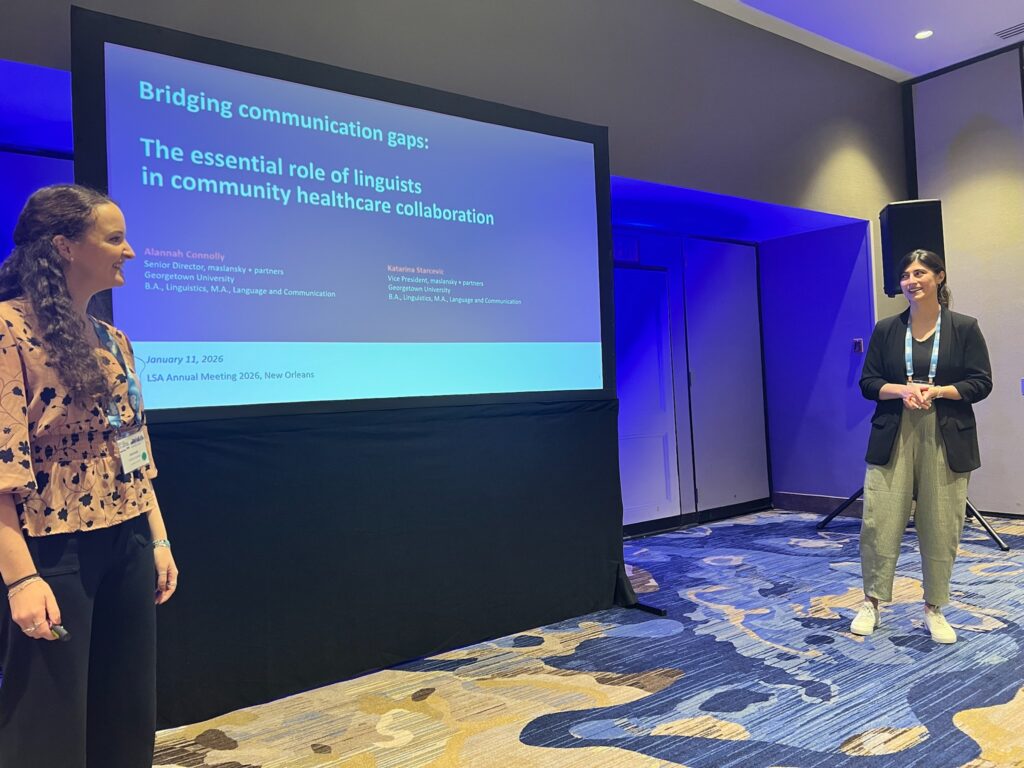
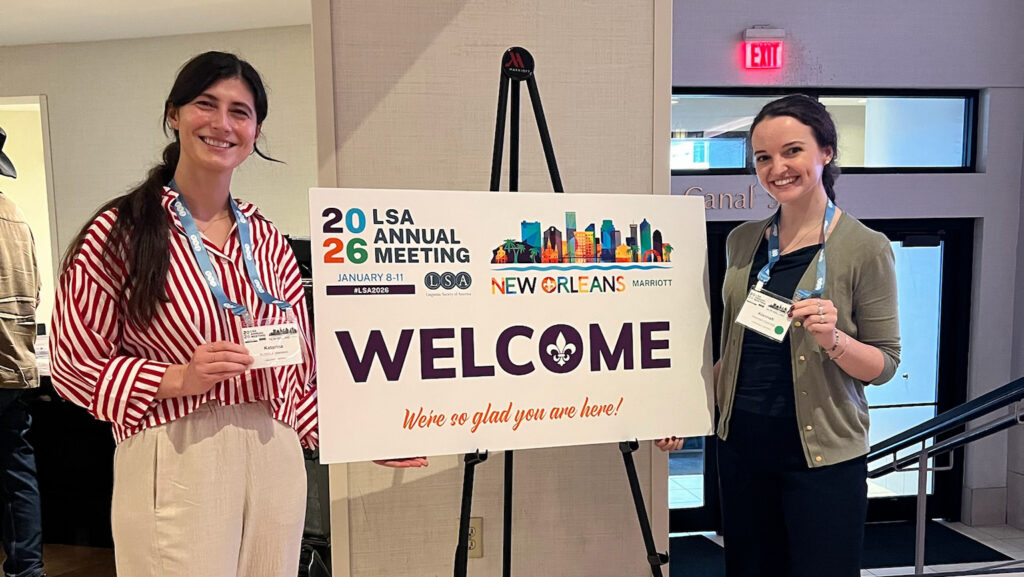
In early January, we found ourselves in New Orleans with hundreds of other linguists, reflecting on these and other language-y questions as we presented at the Linguistic Society of America’s (LSA) Annual Meeting. The meeting brings together academics, researchers, and practitioners from all over the world who care deeply about how language works. And we were lucky enough to be there, sharing not what we’d learned in the classroom, but how linguistic rigor shapes the way we approach language strategy in the real world—especially in our work at maslansky + partners.
The Science Behind the Art
As linguists, we approach language as more than something intuitive, or something you feel your way through. Instead, we treat it the way scientists treat any phenomenon: we look for patterns, we identify variables, we form hypotheses, and we test them rigorously.
When we’re building a Language Strategy to help our clients understand what (and what not) to say, we’re not asking, “What sounds good?“
We’re asking:
What linguistic variables are at play? (Register? Word choice? Framing? Syntax?)
What do we predict will move this audience? And more importantly, why?
How do we test that prediction before we recommend it?
This is the scientific method applied to the art of communication. Instead of microscopes and beakers, we have linguistic frameworks, discourse analysis, and carefully designed research protocols. And it underpins everything we do at maslansky—from how we design research screeners to how we code and interpret what we hear from audiences.
The difference it makes? Our clients aren’t betting on hunches when it comes to the right language to use. They’re betting on evidence.
Solving Real Problems in the Real World
But here’s where linguistics gets really interesting: it’s not just rigorous. It’s useful.
At our LSA presentation, we shared two case studies from work we’ve done in the genomics and community healthcare space. Both presented a similar challenge: how do you help community members and healthcare providers understand—and feel confident in—complex science? And how do you build trust across audiences (from patients and caregivers, to providers and scientists, to advocates and the broader community) that come from very different worlds and often speak very different languages, both literally and figuratively?
Linguists are trained to decode and diagnose exactly these kinds of communication gaps. We understand code-switching, we understand how context shapes meaning, we understand why the same words can land completely differently depending on who’s saying them, to whom, and why.
Across our work, we weren’t just choosing between two ways to say something. We were analyzing how different linguistic choices either bridge or widen the gap between a healthcare institution and the community it serves, including understanding:
How inconsistent language creates barriers (and how to overcome them)
Which frames build trust and which trigger skepticism (and why)
Where stigma and historical baggage get in the way (and how naming it shifts the dynamic)
And how every linguistic choice has the power to shape outcomes

Our work wasn’t just about “better messaging.” It was about linguistic precision applied to a real-world problem with real-world stakes.
The Fun in Wordplay
At the LSA meeting, we also tuned into the latest and greatest – and silliest – in linguistic study, including casting our votes for the storied Word of the Year (2025 was the year of “slop”). And we felt a familiar feeling: how lucky we are to be in a room full of people who get as excited about language as we do.
At m+p, being a “word nerd” isn’t something to apologize for (and the pun is always, always intended). It’s the whole point.
When you set linguists loose on a language problem—when you give us permission to ask the challenging questions, test unexpected hypotheses, and dig into the linguistic weeds—something magical happens. We bring rigor, creativity, and real curiosity about how language actually works. And we turn communication challenges into opportunities for our clients.
We don’t just care about whether something sounds good. We care about whether it’s true, whether it connects, and whether it works – enough to make your audiences listen, care, and act.
So, What’s Your Question?
If we treat language as a science, then every communication challenge is an experiment waiting to happen. Maybe you’re trying to reach an audience that doesn’t trust institutions. Maybe you’re introducing something new and complex. Maybe you’re trying to shift how people think about a problem that’s been misunderstood for years.
Whatever it is, the question isn’t just “What should we say?”
The question is: What’s the hypothesis? What are the variables? And what can looking at language help us discover?
That’s where the real work—and the real magic—begins.
Want to talk about your next language experiment? Let’s connect!