



The language of the outage

Despite all expertise, safeguards, back-ups, and good intentions, companies sometimes make catastrophic mistakes.
As a Language Strategy firm, we know that how companies communicate during and after a crisis has a profound effect on their ability to regain trust… or not. Our battle-tested framework for effective crisis communication goes like this:
- Validate audience concerns
- Describe your actions
- Highlight outcomes
- Add accountability
The research behind that framework tells us that the more severe an event is, the more genuine empathy is required in your response. And a big part of demonstrating empathy is apologizing when it’s appropriate. Also, sounding like a human being.
SOME THOUGHTS ON MICROSOFT’S LANGUAGE IN RESPONSE TO THE OUTAGE
Microsoft 365 Status posts first addressed the outage on November 12 at 12:54 pm.
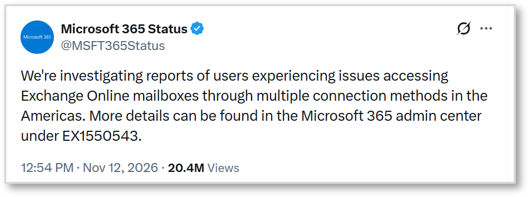
Yes, it was early. But if you’re going to say anything, it’s your chance to validate concerns from the get-go.
Investigating reports of users experiencing issues”
This sounds like they’re not even sure the problem is real. But for countless people and businesses, our work days had already blown up.
Over the next 24+ hours, there were 22 more status updates, which surely were well-intentioned to describe actions and highlight outcomes but had the odd effect of overcommunicating and under-communicating at the same time. Several updates contradicted previous ones. All used head-scratching tech jargon. With the fresh trauma of layoffs across the industry, it feels out of touch to have language that sounds machine-written as the primary communication channel.
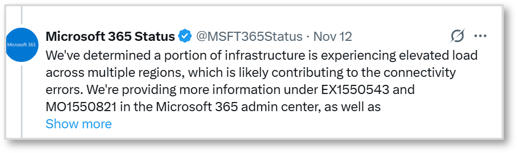
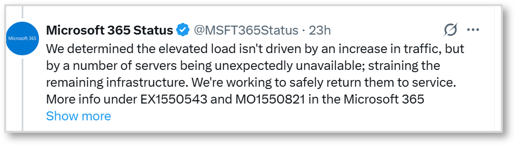
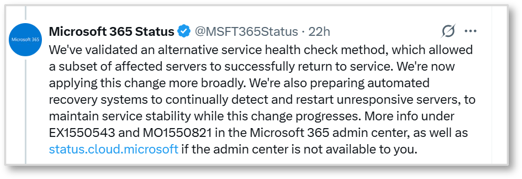
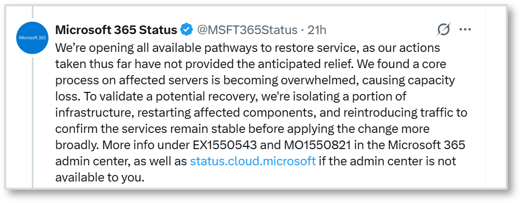
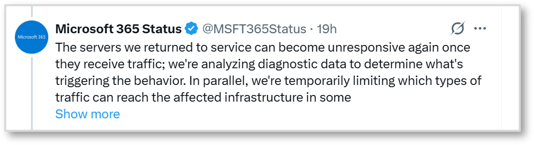
Some hours in, Charles Lamanna, EVP, Copilot, Agents and Platform, replied to one of those updates.
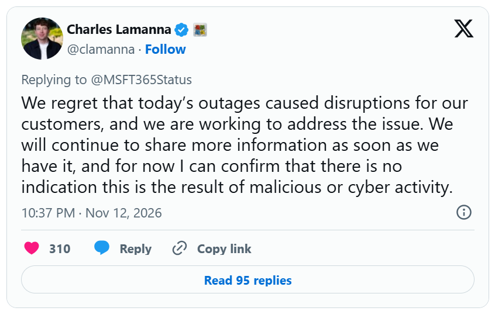
Three great things about this concise message:
✅ Validates concerns by acknowledging the disruption and using the word that everyone affected is using: “outage”
✅ Reassures Microsoft is responding with appropriate urgency
✅ Promises transparency
And a couple thoughts on how we’d advise to clarify and improve:
❎ Apologize. “We regret” isn’t an apology. We all have regrets about Thursday but we’re not responsible for it.
❎ Back up the confirmation of no malicious activity. The status updates made it clear there was trial and error in recovery effort. How do you know? And no “cyber” activity? Isn’t everything you do cyber activity by definition?
Good news—the apology came Friday morning.
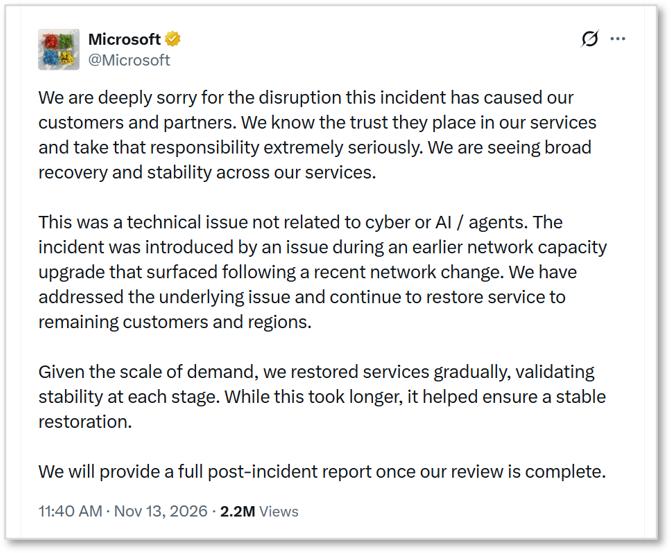
Again, our assessment is mixed.
✅ The apology is unequivocal, which helps it feel authentic, as does recognizing the disruption.
✅ The explanation of why restoration took time is clear and reassuring that it’s under control now.
❎ Intent to explain what happened is good. The twisted path of introduced/earlier/surfaced/recent/underlying is impenetrable. Credibility takes a hit.
❎ It’s almost always a better choice to speak to “you” rather than “they” to help humanize the situation.
❎ Calling it an “incident” detracts from your accountability. It’s an outage.
❎ This would feel so much better coming directly from an executive. Missed opportunity.
At maslansky + partners, we help organizations find the exact language to make people listen, care, and act. Language that builds trust, bridges divides, and brings brands to life.
Whatever communication challenge you’re facing, we’d love to talk about how to tell your story just right. Let’s connect: https://maslansky.com/connect/.