



Is your AI communication sending the wrong signal?

The words companies choose about AI are already shaping whether people trust it, try it, recommend it, or resist it.
Microsoft quietly reshaped the world’s expectations for artificial intelligence, and the change had nothing to do with a breakthrough in model accuracy. It came down to a single word: Copilot.
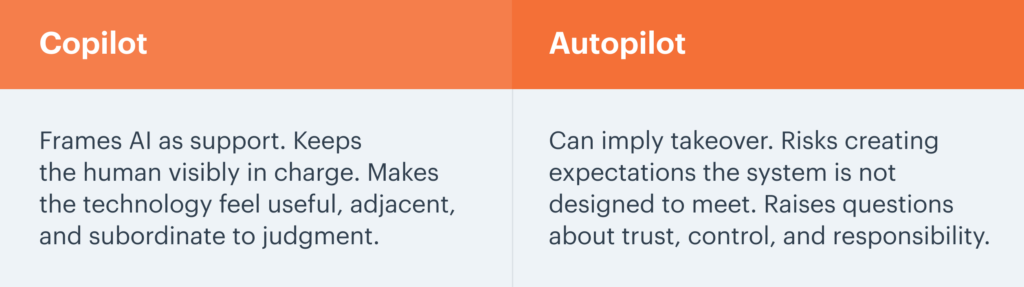
Copilot helped shift how millions of people understood Microsoft’s AI offering by giving an unfamiliar technology a familiar role—one that kept humans visibly in charge. The pilot sets the direction. The copilot helps navigate. AI is useful, adjacent, and subordinate to human judgment. People who were skeptical or anxious found a way to understand what the product was and, more importantly, what it wasn’t.
This is what good language does. It activates a mental model, and once that model changes, so does everything around it: willingness to try it, tolerance for mistakes, expectations about what it could do, and the unspoken assumption about who was still in control.
Now compare that to Tesla’s “Autopilot.”
COPILOT VS. AUTOPILOT: the AI Gap
The surface promise is similar: technology-assisted capability. However, the implication is vastly different. “Autopilot” can suggest a system that can take over. The mental model can race ahead of what the technology is designed to support. Notably, NHTSA made this point directly, warning that the Autopilot name “may lead drivers to believe that the automation has greater capabilities than it does and invite drivers to overly trust the automation.”
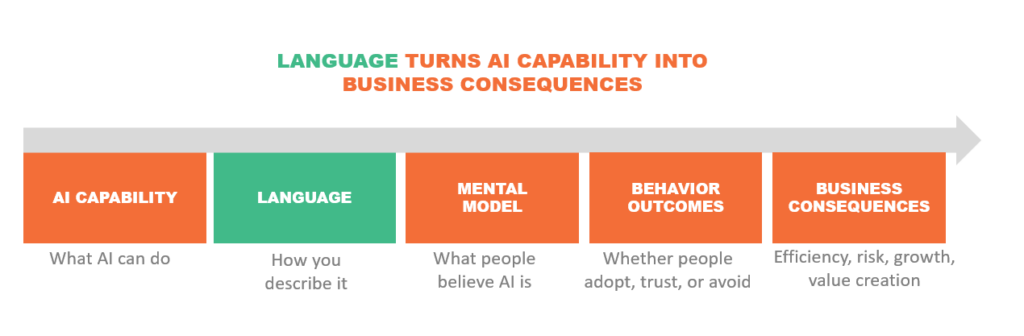
Researchers call this a semantic misalignment: the gap between what a technology can actually do and what its language leads people to believe it can do. In AI, that gap matters because people rarely respond to the system itself but to the role language gives it.
In a recently published study, Pham and Morin analyzed more than 66,000 tweets about generative AI and found that people routinely describe AI as if it were an active agent: something that “thinks,” “helps,” “decides,” or “replaces.” Positive reactions were more associated with AI as a collaborative assistant. On the other hand, negative reactions clustered around job displacement, especially the idea that AI “replaces.”
The research takeaway is simple: AI language does not merely describe a technology. It assigns the technology a role. Essentially, it tells people who is in control, what the technology is allowed to do, and who is responsible when something goes wrong.
The same pattern is starting to show up in market behavior. Investors seem to reward companies that explain AI in a specific, strategic, and credible way. In a recently published study of corporate filings, actionable AI disclosures were associated with roughly a 5.5% increase in market valuation. Vague AI mentions did little. And in categories where competitors are explaining how AI fits the business, silence can start to look like a lack of strategy.
THE SAME PATTERN IS NOW PLAYING OUT INSIDE EVERY ORGANIZATION
It is hard to find a company today that isn’t weaving AI into its operations or customer offerings. Most have an AI roadmap. But far fewer have a language roadmap to help that technology actually land with employees, customers, investors, or regulators.
And yet, consequential language choices are being made constantly: in product names and descriptions, employee communications, sales conversations, investor updates, consumer campaigns, policy documents, and regulatory filings. Each one creates an expectation, assigns a role, and implies accountability.
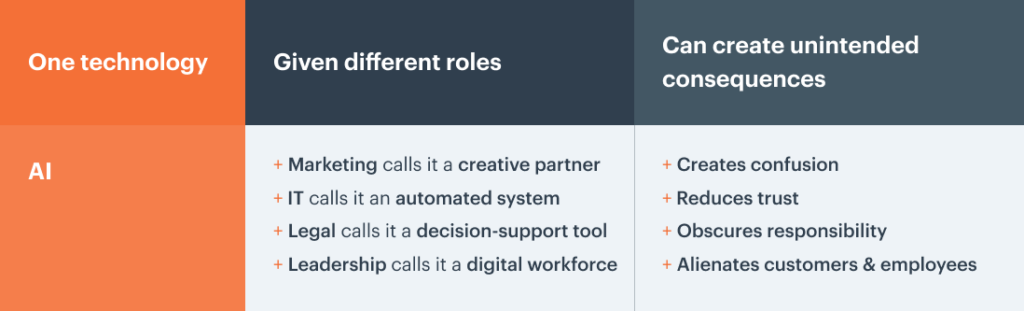
Often, different functions within the same organization assign AI different roles. Marketing calls it a “creative partner.” IT calls it an “automated system.” Legal calls it a “decision-support tool.” Leadership calls it a “digital workforce.”
AI LANGUAGE CHOICES
The language choices used to describe AI are not neutral labels. Each one carries assumptions about agency, autonomy, and responsibility. “Partner” suggests shared work. “Agent” suggests independent action. “Workforce” suggests substitution. So while the technology may be the same, the role people assign to it changes.

At best, inconsistent language leaves a company lost in a sea of interchangeable AI claims. At worst, it creates expectations the technology cannot meet, obscures responsibility, or alienates the audiences whose trust and participation are required.
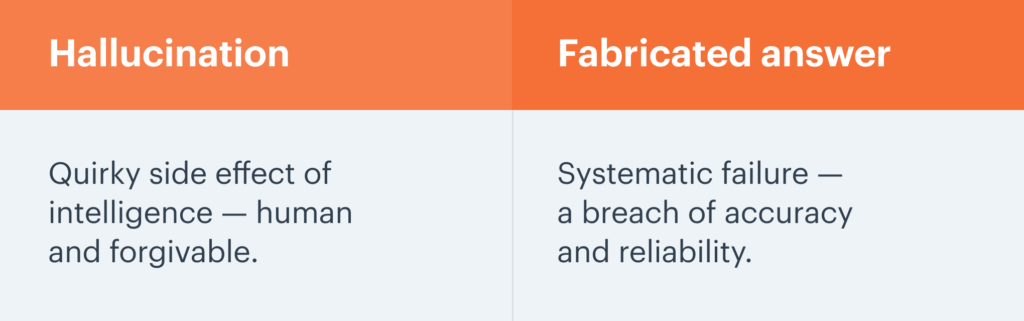
Call an inaccurate AI output a “hallucination,” and it sounds like an amusing quirk — something almost endearingly human. Call the same error a “fabricated answer,” and it feels like a serious, systematic failure. Grammatical construction carries its own weight here. “AI will replace lawyers” places responsibility on the technology. “Law firms may use AI to reduce attorney positions” restores responsibility to organizations making those decisions.
Language shapes who gets credit, who carries the blame, and how much authority technology is quietly allowed to assume over time. Most people will never evaluate an AI product based on a full technical understanding of how it works. The system is too complex and, for most, too opaque. People respond to what they believe the technology is — and that belief is largely built by how you communicate.
THE QUESTION FOR LEADERS
AI will keep outpacing people’s understanding. Consequently, that makes the ability to explain where AI belongs, what it can be trusted to do, and what remains distinctly human a source of competitive advantage.
Employees need to know what AI means for their work and their value. Customers need to understand how AI improves the experience without making it feel opaque. Investors need to see how AI connects to strategy and growth. Regulators need language that signals accountability alongside capability.
The next frontier of AI strategy will be fought in language. Every company is already framing AI. The real question is whether those choices are being made deliberately or whether your AI communication is being written by accident.

How is your company communicating about AI? Are you sending the right message to your employees, customers, investors, or regulators? We’d love to talk with you and help you develop a language roadmap that will help your AI messaging truly land. Let’s connect: https://maslansky.com/connect/.
Citations:
Basnet, A., Elias, M., Salganik-Shoshan, G., Walker, T., & Zhao, Y. (2025). “Analyzing the market’s reaction to AI narratives in corporate filings.” International Review of Financial Analysis.
Petricini, T. (2026). The power of language: framing AI as an assistant, collaborator, or transformative force in cultural discourse. AI & Society.
Pham, T. N. Q., & Morin, C. (2026). “‘Thinking’, ‘helping’, and ‘replacing’: What personification metaphors reveal about the social integration of generative AI.” AI & Society.
Xing, X., Zhang, Z., & He, W. (2026). “AI technology, AI narrative, and firm value.” Technovation.
You Might Also Like
It’s Not What You Say, It’s What They Hear: Michael Maslansky on Language, Trust, and Communicating in the Age of Rage

Three Seismic Shifts in Consumer Expectations—and How Your Business Can Survive the Age of Rage

It’s not fair: how ‘sludge’ and ‘enshittification’ are fueling rage against big business

Do hyperscalers understand the severity of the data center challenge? They better figure it out. Fast.

The Art & Science Behind Language that Works